
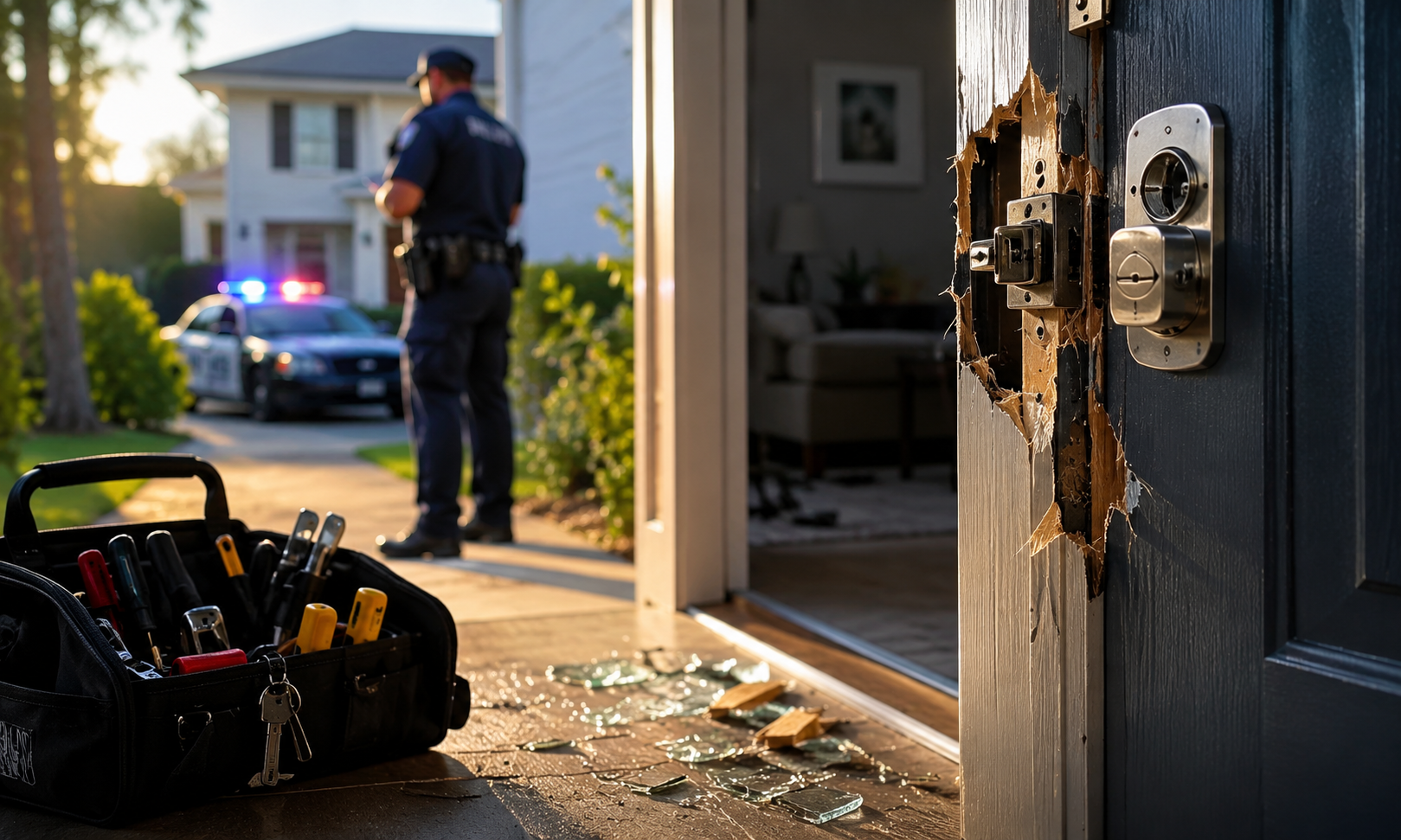
What Should You Do After a Break-In at Your Perth Home?
Discovering your Perth home has been broken into is one of the most unsettling things a homeowner can experience. In the immediate aftermath, it is hard to know what to do first or what order things need to happen in.
The steps you take in the first few hours matter. They affect your safety, your insurance claim, the police investigation, and how quickly your home can be properly secured again.
This guide walks through everything clearly: what to do before you re-enter, who to call and in what order, how to assess the damage, and what security decisions to make once the crisis has passed.
Key Takeaways
- Do not enter the property until WA Police have attended and confirmed it is safe to go back inside.
- Call WA Police on 131 444 to report the burglary. An event number from this call is required for most home insurance claims in Western Australia.
- Once police have cleared the scene, a locksmith can secure forced entry points, assess damaged locks, and rekey or replace hardware depending on what the break-in involved.
- Do not clean up the scene, move items, or touch surfaces around the entry point before police have attended and photographed the area.
- Most Australian home and contents insurance policies cover emergency locksmith costs and lock replacement after a confirmed burglary. Keep every receipt.
Step 1: Do Not Go Inside
If you arrive home to find signs of a break-in, the instinct to go straight in and check your belongings is understandable. Resist it. Until you know the property is clear, re-entering could be dangerous.
Burglars are sometimes still on the premises when a homeowner returns. Stay outside, move to a safe distance from the property, and call WA Police before doing anything else.
While you wait, note what you can observe from outside without disturbing the scene: which entry point appears to have been used, whether any doors or windows are visibly open or damaged, and whether anything appears to have been moved or removed from visible areas near windows.
Need urgent help securing your home after a break-in?
Our Perth emergency locksmiths can secure damaged locks, rekey doors, and restore your home’s safety fast.
Step 2: Call WA Police
Dial 131 444, which is the WA Police non-emergency line for reporting crimes including burglary. If you believe the intruder is still on the premises or nearby, call 000 immediately.
When you speak to police, give your address, describe the signs of entry you observed, and confirm whether you have checked the interior. Police will attend to search the premises, make the scene safe, and document the incident.
Why the Police Event Number Matters
The event number issued by WA Police when you report the burglary is required by most home and contents insurers when you lodge a claim. Without it, many insurers will not process a claim for stolen goods, damaged property, or emergency locksmith costs. Obtain this number and keep it with your other incident documentation.
Step 3: Do Not Touch or Clean Up Before Police Attend
This step is frequently overlooked in the distress of the moment. Fingerprints, footprints, tool marks near the entry point, and disturbed items are all potential evidence. Moving or cleaning up any of this before police have attended and documented the scene can compromise what investigators can recover.
Specifically, avoid touching door frames, window ledges, or lock hardware near the forced entry point. Do not pick up broken glass or replace any items that have been moved. If you need to re-enter to check on a dependent or pet, do so with care and disturb as little as possible before police arrive.
Step 4: Secure the Property After Police Attend
Once police have attended, cleared the scene, and documented the entry point and any disturbed areas, the immediate priority is making the property secure again. This is where a locksmith becomes essential.
A 24-hour emergency locksmith in Perth can attend at any hour after a break-in to assess which entry points are compromised, board up or temporarily secure doors and windows that cannot be fully repaired immediately, replace forced or damaged locks, and advise on whether existing undamaged locks should be rekeyed given the circumstances.
What the Locksmith Will Assess
- Forced entry point: If the door frame was kicked in or the lock was physically broken, the hardware will need replacement. A forced deadbolt or destroyed lock cylinder cannot simply be rekeyed.
- Undamaged locks on other doors: If the intruder entered through a specific point and other locks appear untouched, rekeying those locks resets key control in case any keys were taken during the burglary.
- Door frame and strike plate condition: Many Perth break-ins involve kicking a door in rather than picking the lock. The damage is often to the frame and strike plate rather than the lock itself. A locksmith can assess what repairs are needed to restore proper function and resistance.
- Window locks and secondary entry points: An experienced locksmith will check secondary entry points including windows, sliding doors, and any door that appears to have been tested during the break-in.
For properties where the damage extends beyond the lock hardware itself, burglary repair services in Perth cover the broader scope of making entry points structurally sound again, including frame repairs and reinforcement alongside lock replacement.
Step 5: Rekey vs Replace. Understanding the Difference After a Burglary
The decision between rekeying and replacing locks after a break-in depends on the condition of the existing hardware and the nature of the entry.
When Replacement Is Needed
If the lock was the direct target of the break-in, whether through drilling, picking, snapping the cylinder, or forcing the mechanism, the lock body is compromised and must be replaced. Attempting to rekey a physically damaged lock is not appropriate.
The same applies where the door frame or strike plate has been significantly damaged. Even a perfectly functional lock provides limited security when the door frame around it has been weakened by a kick or forced entry attempt.
When Rekeying Is Appropriate
If the intruder entered through a window, a door with a different lock, or by some means that did not involve your lock hardware, the physical condition of your locks may be fine. In that situation, the concern is whether the burglars took any keys during the break-in, or whether they previously had access to a copy.
Rekeying changes the internal pin configuration of the lock so that any old keys, including ones that may have been taken, no longer work. A more detailed look at when rekeying makes more sense than replacing locks covers the mechanics and cost differences for Perth homeowners working through this decision.
Step 6: Document Everything for Your Insurance Claim
Once the scene has been attended by police and the property is secured, begin documenting everything you can before items are cleaned up or repaired.
- Photograph all damage: Entry points, broken locks, smashed windows, forced frames, and any areas inside the property that were searched or damaged.
- List all missing items: Go through every room and document anything that appears to have been taken. Serial numbers, purchase receipts, and photos of high-value items will support your insurance claim.
- Keep all receipts: Locksmith call-out fees, lock replacement costs, boarding up, temporary security measures, and any emergency hardware are all claimable expenses under most policies.
- Contact your insurer promptly: Most policies require you to report a claim within a defined timeframe, typically within 24 to 72 hours of the incident. Contact your insurer as soon as you have the police event number.
Step 7: Notify Relevant Parties
Beyond police and your insurer, several other parties may need to be informed depending on your circumstances.
- Your landlord or property manager: If you are renting, your landlord needs to be notified immediately. Responsibility for lock replacement and structural repairs in a rented Perth property typically falls to the landlord, not the tenant.
- Your bank: If financial documents, bank cards, or statements were among the stolen items, contact your bank to place holds on accounts and request replacement cards before they can be used.
- Neighbours: Letting nearby neighbours know a break-in occurred in the area is a reasonable precaution. Neighbourhood watch groups and local community Facebook groups in Perth suburbs are often useful for circulating information quickly.
- The ATO and Services Australia: If tax documents, Medicare cards, or Centrelink paperwork were among stolen items, reporting this reduces the risk of identity fraud.
Assessing Your Home’s Security After the Break-In
Once the immediate crisis is resolved, it is worth stepping back and thinking about what the break-in revealed about your property’s vulnerabilities. Most Perth residential burglaries are opportunistic rather than targeted. Entry is typically attempted through the path of least resistance, which is often an unlocked secondary door, an easily forced back gate, or a sliding door with a basic pin-style lock.
Common Vulnerability Points in Perth Homes
- Sliding glass doors: A common weak point in Perth homes. Secondary security devices, anti-lift bars, or purpose-built secondary locks significantly improve resistance.
- Side and rear gates: Many Perth burglars enter through the back of a property. A deadbolt or heavy-duty padlock on the side gate, combined with adequate fencing height, raises the barrier considerably.
- Fly screen and security screen doors: Security screen doors are more resistant than standard fly screens, but the lock and frame quality vary significantly. A locksmith can advise whether your screen door hardware is adequate.
- Exterior lighting: Motion-activated lighting on the rear and sides of the property removes the low-visibility conditions that opportunistic burglars rely on.
- Door frame strength: The deadbolt itself is rarely the weak point on a Perth front door. The frame and strike plate around it are. Long-screw strike plate upgrades and reinforced door frames are cost-effective improvements that significantly increase kick-in resistance.
For a broader look at the security measures that address Perth residential vulnerabilities before they become problems, the guide to security measures that deter burglars in Perth covers practical upgrades across all the main entry points in a typical Perth home.
Digital Locks as a Post-Burglary Upgrade
For homeowners who want to rethink their security entirely after a break-in, digital locks offer a meaningful change in how access is controlled. The most significant advantage in the context of a burglary is that there are no physical keys to steal, copy, or hand on to others.
A digital lock that grants access via PIN code, fingerprint, or Bluetooth app removes the key control problem entirely. If someone gains access to your property and memorises or notes your PIN, you can change it in seconds without calling a locksmith or paying for rekeying. The entire concept of access control becomes something you manage directly rather than something that depends on physical key possession.
Perth locksmiths who supply and install digital locks can advise on which models suit specific door types, including heritage doors in older homes, aluminium-framed doors common in Perth’s newer suburbs, and security screen doors where digital locks are now available as an integrated option.
What Not to Do After a Perth Break-In
A few specific mistakes are worth naming directly because they are common and each one has real consequences.
- Do not post about it on social media immediately: Announcing that your home was broken into and describing what was taken can alert others to an unoccupied or newly unsecured property, and in some cases, alerts the original perpetrators that specific items were taken.
- Do not accept a locksmith quote without checking their licence: In Western Australia, locksmiths must hold a Security Agent’s Licence under the Security and Related Activities (Control) Act 1996. An unlicensed locksmith working on your locks after a burglary may void your insurance cover. Check licence status through the WA Police Licensing portal before authorising any work.
- Do not delay securing the property overnight: A property that has been broken into once is at elevated risk of a second entry that same night or in the days immediately following. Secure every entry point before leaving the property unoccupied.
- Do not dispose of broken lock hardware: Insurers may require inspection of damaged hardware as part of the claims process. Keep broken locks, cylinders, and any fragments until your claim is settled.
Frequently Asked Questions
Should I call the police before a locksmith after a break-in in Perth?
Yes. Always call WA Police first on 131 444 to report the burglary and get an event number for your insurer. Once police have cleared the scene, call a locksmith to secure the property immediately.
Can a locksmith come immediately after a break-in in Perth?
Yes. Emergency locksmiths in Perth operate 24 hours a day, 7 days a week. After a burglary, most Perth locksmiths prioritise emergency call-outs and aim to arrive within 30 minutes of your call.
Should I rekey or replace my locks after a break-in in Perth?
Replace locks that were forced or damaged. If entry was through a window or door frame rather than the lock itself, rekeying undamaged locks is often enough to reset key control on the property.
Does home insurance cover locksmith costs after a burglary in Perth?
Most Australian home and contents policies cover emergency locksmith and lock replacement after a break-in. Keep all receipts and have your police event number ready when you lodge the claim.
What security upgrades should I consider after a Perth burglary?
Consider upgrading to a deadbolt or digital lock on the front door, adding a secondary lock to sliding doors, improving exterior lighting, and installing a monitored alarm if you do not have one.
Getting Your Home Back to Secure
A break-in leaves most people shaken, and understandably so. Working through the immediate steps in the right order, police first, then locksmith, then documentation, keeps the response clear and protects your options for the insurance process.
Once the property is secured and the paperwork is in order, the break-in is also an opportunity to identify and address the vulnerability that allowed entry in the first place. A locksmith who attends for emergency repairs can provide an honest assessment of what made the property accessible and what practical steps reduce that risk going forward.


 24-Hour Emergency Service